
A consortium comprising Aditya Birla Group, The Times of India Group, Bolt Ventures and a Blackstone fund has acquired Royal Challengers Bengaluru (RCB) for $1.78 billion, setting surging valuation benchmarks for T20 franchises in the Indian Premier League.
The Rajasthan Royals (RR) franchise scored a $1.6 billion valuation in a sale to entrepreneur Kal Somani, supported by Rob Walton of Walmart and the Hamp family of Ford Motor, both of whom own franchises in the National Football League (NFL), US. The RR deal marks the entry of global sports franchise owners into Indian cricket.
RCB is valued more than twice the benchmark set last year when Torrent Group acquired the Gujarat Titans at a $900 million valuation —a sharp increase driven by the fan engagement and advertising pull of India’s most watched cricket tournament. It is also a nearly 16x jump from its original bid value.
The acquirers of RCB will get the men’s team as well as the franchise’s team in the Women’s Premier League.
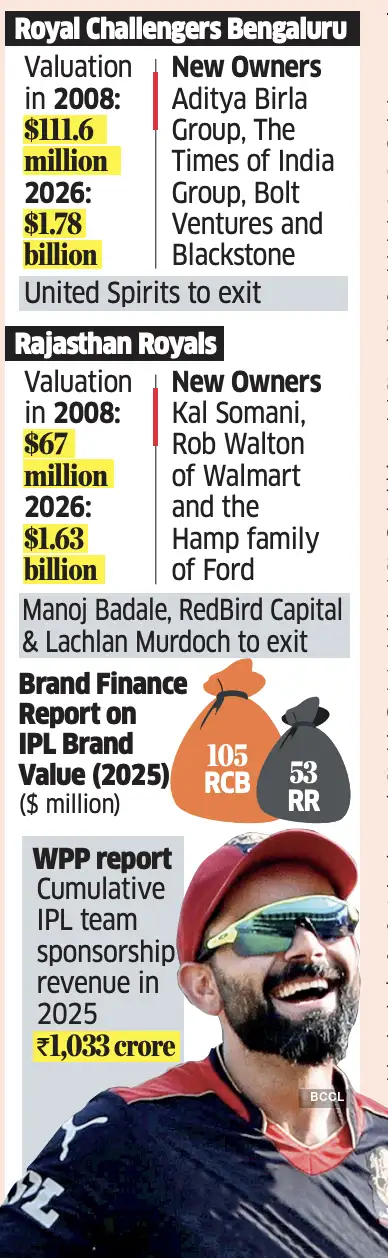
For selling party United Spirits (USL), a subsidiary of Diageo plc, the transaction represents an almost 16 times appreciation over the 2008 bid value.
Under the new ownership structure, Aryaman Vikram Birla, director of Aditya Birla Group, will serve as chairman, and Satyan Gajwani of The Times of India Group will serve as vice-chairman of the franchise.
Rajasthan Royals, among the cheapest franchises at $67 million in 2008, has seen its value jump nearly 25x to $1.63 billion. In 2021, Manoj Badale’s Emerging Media Ventures raised its stake in Rajasthan Royals from 51% to 65%. That same year, US-based RedBird Capital Partners bought 15% for $37.5 million, valuing the franchise at about $250 million. The latest deal marks a more than sixfold jump.
The transactions will mark two full secondary buyouts of IPL teams in the league’s 18year history.
Last year, the IPL attracted one billion viewers across television and digital, which is an unmatched reach for a single market. The National Basketball Association (NBA) reaches 800 million to one billion viewers, and the English Premier League 1.87 billion viewers globally.
The two acquisitions are subject to customary closing conditions, including approval from the Board of Control for Cricket in India (BCCI), the IPL Governing Council and other applicable regulatory authorities.
The new owners will have to pay 5% of the transaction value to the BCCI as transaction fee for change in ownership, which translates to $90 million for RCB and $80 million for RR.
“It is a privilege to come together in this partnership to shape the next phase of growth for RCB,” said Aryaman Birla. “This partnership brings together a deep understanding of sports, media and consumer businesses. Together, we will continue to play bold—on the pitch, in the community, and for the fans who make RCB what it is.”
The RCB bidding, which saw competitive bids from multiple consortia, saw the winning consortia outbid an offer from Serum Institute’s Adar Poonawala and Aditya Mittal of ArcelorMittal. Premji Invest with private equity firm EQT and another consortium comprising Manipal Group’s Ranjan Pai, KKR and Temasek also put in bids in the early rounds of the contest.
The Times of India Group’s Gajwani said the consortium intended to build a global sporting institution rooted in Bengaluru and Karnataka. “RCB is the reigning champion and the most popular brand in the IPL. As The Times of India Group, together with our partners, we will build RCB into a global sporting institution, while remaining rooted in Bengaluru and Karnataka and its incredible fanbase. We are committed to the people who built this championship-winning culture—the players, coaches, the leadership team, and the fans. We look forward to supporting the team as they take the pitch on Saturday to defend RCB’s title.”
The Times of India Group is the publisher of The Economic Times.
David Blitzer, founder of Bolt Ventures, said, “RCB has a world-class fanbase, and the IPL is one of the great growth stories in global sport. Having invested in clubs and leagues around the world, I believe the opportunity at RCB stands out. We look forward to working alongside our partners and BCCI to build on the franchise’s championship success.”
In FY25, RCB recorded profit of ₹140 crore on revenue of ₹515 crore. Royal Multisport, the owner of Rajasthan Royals, recorded a turnover of ₹634 crore. In 2008, RCB was bought by Vijay Mallya, then promoter of United Spirits, for $112 million.
The new owners of RCB and RR bring deep global sports pedigree.
Bolt’s Blitzer, who is also founder and managing partner of Harris Blitzer Sports & Entertainment, has stakes in teams such as the NHL’s New Jersey Devils, NBA’s Philadelphia 76ers, Crystal Palace FC of English Premier League and Nascar team Joe Gibbs Racing. The Times of India Group promoters have also backed Major League Cricket, while Aditya Birla Group will be entering the sports business through this deal.
Somani is a co-owner of Motor City Golf Club and an early investor in TMRW Sports and the TGL Golf League.
The Rajasthan Royals consortium includes Walton, owner of the NFL’s Denver Broncos, along with the Hamp family, which owns the Detroit Lions.
Experts say the latest transactions underscore IPL’s evolution from a league into a globally investable sports property, drawing interest from both leading domestic players and global capital.
“From early franchise investments to current valuations, #IPL assets have consistently compounded in value. Sport in India is no longer just passion. It is a powerful, investible asset class,” Sanjiv Goenka, chairman of RPSG Group and owner of Lucknow SuperGiants, posted on X.
The surge in interest comes amid a broader boom in global sports valuations. Forbes reported that the world’s top 50 sports teams were collectively worth more than $353 billion in 2025, up 22% from a year earlier. The Dallas Cowboys topped the list at $13 billion, with even the lowest-ranked team valued at $5.4 billion.
Industry executives say IPL is evolving from a domestic corporate and celebrity-led league into a magnet for global private equity and sports capital. Its owners include India’s richest man, Mukesh Ambani (Mumbai Indians), filmstar Shah Rukh Khan (Kolkata Knight Riders), industrialist Sanjiv Goenka (Lucknow SuperGiants) and media baron Kalanithi Maran (Sunrisers Hyderabad).
Driving the surge is the Board of Control for Cricket in India’s $6.2-billion media rights deal signed in 2022, which transformed franchise economics. Teams are now generating annual profits estimated between ₹100 crore and ₹200 crore.
Scarcity, with just 10 teams, and cricket’s vast audience of more than a billion in India, are also fuelling valuations. “IPL franchises are trophy assets now,” said a franchise CEO, speaking on condition of anonymity. “Everyone wants exposure to that growth, and media rights values still have room to rise.”
In an earlier interaction, Arun Dhumal, chairman of Indian Premier League, said it continues to attract new advertisers, even as categories such as fantasy gaming recede. He expects competition for media rights to intensify in the next cycle. “The current broadcaster is seeing strong monetisation, but we expect new bidders, going forward,” he said. “Franchise valuations will track that growth. The IPL brand remains resilient.”
In FY25, BCCI generated ₹12,005 crore in revenue from the IPL, including media rights, franchise fees and sponsorship, compared with ₹11,801 crore in the previous year.
The profits generated by IPL teams, driven by rising media rights and sponsorship income, have enabled franchises to reinvest in global cricket leagues such as The Hundred, SA20, Major League Cricket in the US, International League T20 and Women’s Premier League in India.
Source: Economic Times