
US buyout group TPG, along with consortium partners ICICI Bank and GIC of Singapore, has agreed to buy non-bank lender Aseem Infrastructure Finance Ltd (AIFL) for Rs 4,000 crore as it looks to accelerate green funding and investment initiatives in the country, said people aware of the matter. The three sponsors of the NBFC will exit as part of this deal, they added.
A binding agreement will be finalised over the next few days. Aseem Infrastructure was set up six years ago to provide debt funding for long-term core sector projects with a special emphasis on clean energy.
Its sponsors include the National Investment and Infrastructure Fund II, which holds a controlling 59% stake. The government of India (GoI) is also a shareholder with a 31% stake through a direct investment. The balance 10% is held by Japan’s Sumitomo Mitsui Banking Corp (SMBC). The acquirers will be taking over the entire team, the Rs 1,800 crore loan book as well as the Aseem brand.
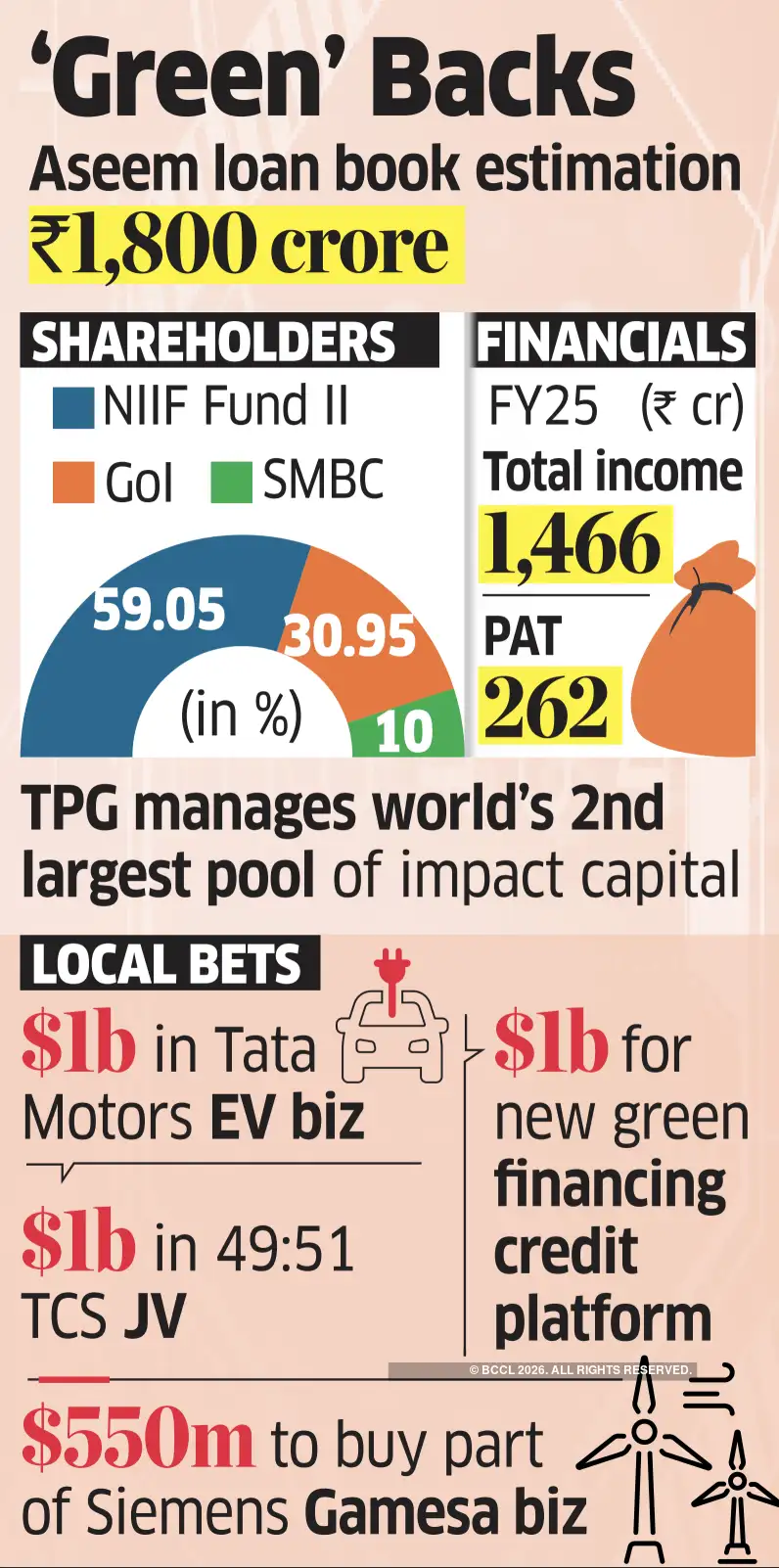
TPG had earmarked a $1 billion initial investment for a first-of-its-kind green financing platform in India under the aegis of TPG Rise Climate to help enterprises in developing economies in India to transition from legacy energy systems reliant on fossil fuels to greener options. ET was first to report this in November 2024. Since then, it has roped in ICICI Bank and GIC of Singapore as co-investors of this yet-to-be-named platform. The initiative will be helmed by former Barclays banker Hardik Dalal and Manish Chourasia, who used to be managing director of Tata Cleantech Capital Ltd.
TPG, NIIF declined to comment. GIC of Singapore, SMBC, ICICI Bank and the finance ministry didn’t respond to queries.
Aseem is expected to be valued at around one-and-a-half times book value, implying a transaction size that would rank among larger equity bets in the country’s infrastructure lending space. The transaction will also include the transfer of 30% stake held by Aseem in NIIF Infrastructure Finance Ltd (IFL), another NBFC. But NIIF will be buying the stake back from the acquirers.
“The total transaction value will be closer to Rs 5,000 crore but since NIIF will be buying back its stake, the net proceeds for the sponsors of Aseem will be Rs 4,000 crore,” said an official.
AIFL raised Rs 1,287 crore through two rounds of capital infusions by NIIF in January 2020 and May 2020, followed by about Rs 947 crore from NIIF and GoI in March 2021 and subsequently Rs 317 crore from SMBC in March 2022.
GoI had committed equity infusion of Rs 6,000 crore in the two NIIF debt platforms — AIFL and NIIF IFL — as part of the National Infrastructure Pipeline (NIP). This is over and above GoI’s capital commitment of Rs 20,000 crore to the NIIF platform.
Aseem reported a networth of Rs 3,267 crore on March 31, 2025. The company has gradually added greenfield projects to its portfolio (22% of the total Rs 15,156 crore book on March 31, 2025).
While the addition of under construction projects adds to portfolio vulnerability due to project execution risks, AIFL has mitigated the risk to an extent by being selective in its lending to projects with relatively better credit profile and investing in the later stages of greenfield projects, most of which have successfully achieved completion and commercial operation dates, noted ICRA in a credit report from last June.
The management’s stated intention of ensuring operational projects continue to account for a major share of the overall mix over the medium term also ensured zero delinquencies. Over the past two years, AIFL’s focus has gradually shifted toward achieving sustainable profitability and expanding assets under management (AUM) in a calibrated manner at a CAGR of around 15-20% in the medium term.
Green Push
TPG has been working with consulting firm McKinsey to finalise the investment strategy and focus for the green lending platform, said the people cited. The platform will look at the broad spectrum of green financing, of which renewables is only a part. As per McKinsey’s calculations, efforts to finance energy transition toward greener and cleaner options in the country face an annual deficit of $100-125 billion.
For TPG, green financing will cover the entire gamut ranging from renewable power producers or their supply chains, to helping them with project finance, working capital, even at the construction stage. It also plans to cover the renewable energy vendor ecosystem as well as the recycling industry as part of electric vehicle (EV) fleet management besides transition finance for industrial decarbonisation in core sectors.
The Aseem transaction will provide the platform’s building blocks. The PE group has been proactively scouting for investment opportunities in this space. Last March, along with partners, it struck a deal with Siemens Gamesa, the wind power subsidiary of Siemens Energy, to buy a majority stake in its onshore wind turbine generator manufacturing business in India and Sri Lanka for $550 million. This was the first investment from its Global South initiative launched at the COP28 climate change summit last year in partnership with Altérra.
Later in the year, it deployed Rs 8,820 crore ($1.1 billion) to team up with Tata Consultancy Services (TCS) for a 49:51 joint venture to create gigawatt-scale, AI-ready data centres. It already has signed up AWS and Open AI as tenants. TPG also led a $1 billion investment in Tata Motors’ electric vehicle business.
Source: Economic Times