
India plans to set up a special bench of the National Company Law Tribunal (NCLT) with trained manpower to handle cross-border insolvency cases once the new bankruptcy rules are notified, to fast-track proceedings, people aware of the matter said.
The cross-border framework, approved last month as part of amendments to the Insolvency and Bankruptcy Code (IBC), will be based on a model UN law with modifications to suit the Indian context.
It seeks to enable easier access for creditors to overseas assets of stressed companies and allow India to seek cooperation from foreign courts to bring such assets under insolvency proceedings.
The need for such a framework emerged during bankruptcy proceedings involving Amtek Auto, Videocon Industries, Essar Steel and Jet Airways, where issues such as asset location and complex cross-border procedures delayed resolution.
The corporate affairs ministry will begin framing cross-border insolvency rules soon. To ensure parliamentary oversight, a draft of every rule will have to be laid before each House of Parliament, as per the amended IBC.
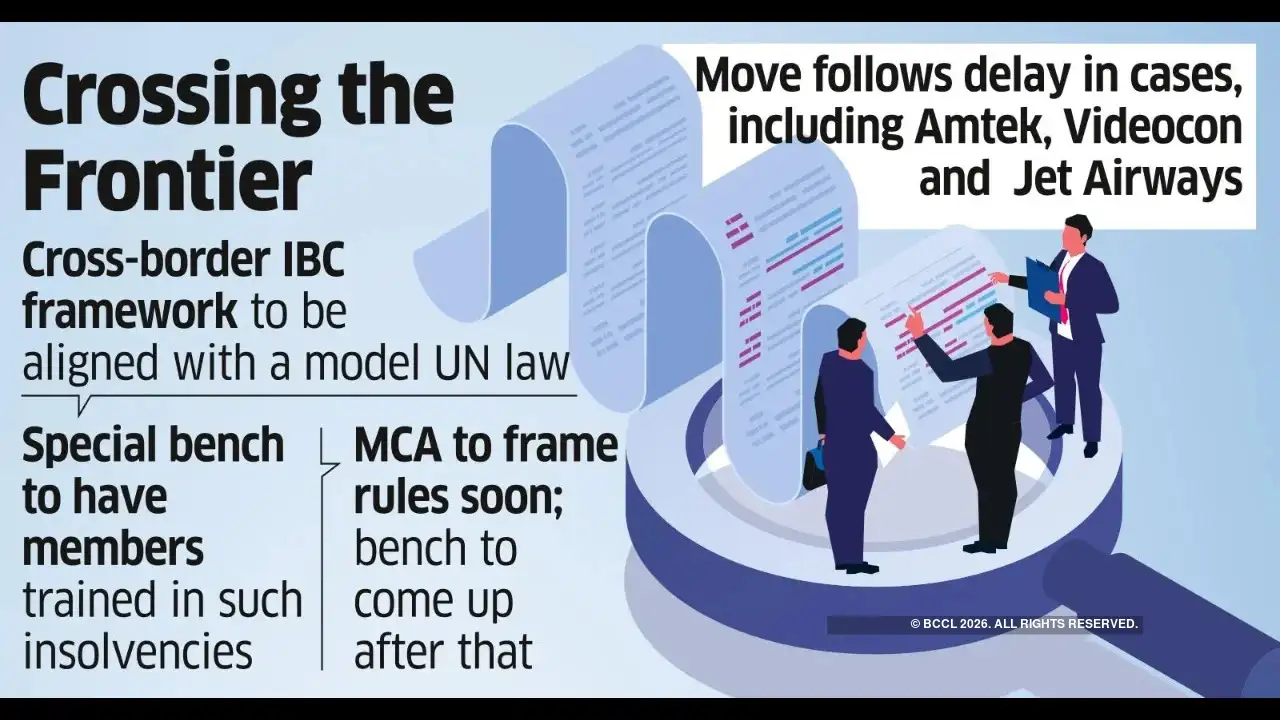
Rules to enable easier access for creditors to global assets of stressed cos and allow cooperation from foreign courts
“The special bench is necessary for time-bound insolvency proceedings,” one of the people told ET.
“We can’t have a situation where a foreign adjudicating authority hearing the insolvency case is moving fast and we are lagging,” he said. Advanced jurisdictions, including Singapore, are known for time-bound resolutions.
The proposed NCLT bench will have members trained in cross-border insolvency resolution, the person said.
Model UN framework
The United Nations Commission on International Trade Law (UNCITRAL) for cross-border insolvency resolution has been adopted by more than 50 jurisdictions.
It is based on principles such as access to foreign and domestic courts by resolution professionals, recognition of foreign proceedings, cooperation between courts, and coordination of multiple concurrent insolvency proceedings. Ratifying countries are allowed to firm up rules, depending on their peculiar context, on the basis of this model law.
“A special bench will result in faster resolution of cross-border insolvency cases. This will brighten the chances of recovery for creditors as well,” said Yogendra Aldak, executive partner at Lakshmikumaran & Sridharan attorneys.
Earlier, the IBC provided for cross-border insolvency through bilateral agreements and letters of request issued by the NCLT to foreign courts under Section 234. However, this mechanism was ad hoc and prone to delays and uncertainty.
Source: Economic Times